
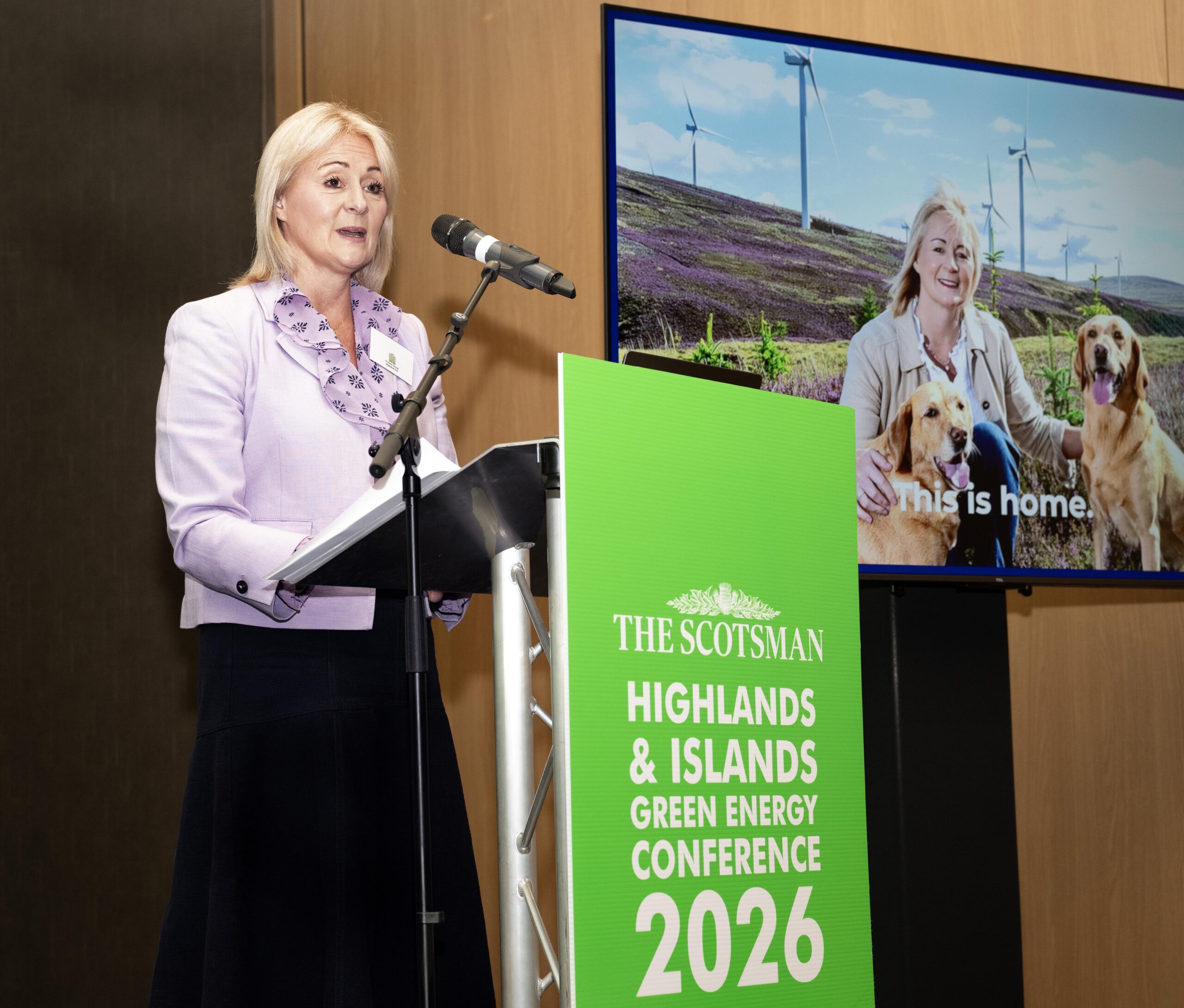
History won’t judge us by the turbines we built
Yvonne Crook, Chair, Highland CIC
History won’t judge this generation by the turbines we built or the pylons we erected.
It will judge us by what we chose to build around them.
The Highlands stand at one of the most significant moments in its history. For the first time in generations, we have an opportunity to shape our own future. The energy transition gives us the chance to think differently about the kind of place we want to become and the legacy we want to leave behind.
At Highland CIC, we are a Community Interest Company founded by people who care deeply about the Highlands and are embracing the opportunity the energy transition is bringing. We believe this moment comes with a shared responsibility: to look beyond individual projects, work across organisational boundaries and think beyond today’s challenges. Because the decisions we make now won’t just shape the energy transition. They’ll shape the future of the Highlands.
This belief didn’t emerge overnight. Over the last five years, Highland CIC has had the privilege of listening to communities, developers, contractors, businesses, charities and public sector partners from across the Highlands. We’ve had more than 1,500 conversations, worked alongside over 45 organisations, and attracted more than £1.2 million of private sector investment to support this journey.
This isn’t a statement of what Highland CIC thinks. It’s a reflection of what we’ve heard: a vision shaped by hundreds of voices and a growing recognition that the energy transition gives us an opportunity to think strategically about sustainable development, to look beyond individual projects, and to ask how this unprecedented investment could help us tackle challenges that might otherwise remain with us for decades.
Across every conversation, one question kept coming back: who benefits?
It wasn’t about creating winners and losers, and it certainly wasn’t because community benefit hasn’t been a success. Community benefit has transformed lives, strengthened communities and enabled projects that simply wouldn’t otherwise have happened. Host communities deserve to continue benefiting from the developments they welcome. But as we looked at the scale of the challenges and the opportunity emerging across the Highlands, it became clear that there was an even bigger conversation to be had.
With support from SSEN Transmission, we commissioned strategic mapping to help us understand the scale of the energy transition across the Highlands and begin exploring what it could mean for our communities and our future. The completion of the mapping exercise was the moment we stopped seeing individual projects and started seeing the foundations of something much bigger.
I grew up in Altnaharra and went to primary school there. For the past eighteen years I’ve lived in Moy, part of the Strathdearn community. Living there means I can’t help but reflect on the changes happening around us. In one direction is Altnaharra – a community that has benefited from renewable energy and community benefit funding, yet the primary school where I began my education has now closed. In another is Moy – a community with more than £5 million in renewable assets, while just 30 minutes away are communities with no community benefit funding at all.
I’ve spent much of my career working in destination development across the UK and Europe, seeing first-hand what can be achieved when places come together around a shared long-term vision. Standing in the middle of that landscape, I came to realise that the real opportunity wasn’t the energy transition itself. It was what the energy transition could enable.
When I look at the map of renewable development across the Highlands, I don’t just see projects. I see the foundations of something much bigger. And after five years of listening, as a community interest company, we’ve come to a conclusion.
Community benefit has been a success. Across the Highlands, it has transformed communities, created remarkable local assets and made possible projects that simply wouldn’t otherwise have happened. But the scale of the opportunity before us has changed. Over the coming decades, billions of pounds of energy transition investment and hundreds of millions of pounds of community benefit funding will flow into the Highlands. That presents an opportunity unlike anything we’ve experienced before, and we believe it challenges us to think differently by taking an equally ambitious and strategic approach to the future of the Highlands.
Take Loch Ness as an example. Around 10,000 people live in the communities surrounding the loch. Every year, renewable developments in the area are expected to generate between £2 and £3 million in community benefit funding – around 10% of all community benefit funding in Scotland. Over the lifetime of those developments, more than £50 million will flow into the communities around the loch.
For me, that’s much more than a funding figure. It’s an opportunity to demonstrate what sustainable development could look like in practice. Loch Ness is one of the world’s most recognised destinations, balancing global tourism with significant renewable development, the world’s first rewilding centre and globally significant restoration initiatives, as well as the needs of the communities that call it home.
Imagine what could be achieved if communities, developers, businesses and public sector partners came together around a shared long-term vision. Not to replace local priorities, but to connect them. To explore how renewable energy investment could help shape the future of one of Scotland’s most iconic places. Loch Ness could become more than an example of community benefit done well. It could become a living example of sustainable development in action, creating lessons for communities across the Highlands and beyond.
And then there’s Tain. A proud Highland town, sitting at the heart of one of Scotland’s most significant industrial and energy investment corridors, yet it remains amongst the 15% most deprived areas in Scotland.
Loch Ness and Tain are just two examples. There are many more across the Highlands, each with their own opportunities and challenges. But they all lead to the same conclusion: the Highlands has an extraordinary opportunity, and it deserves an equally extraordinary strategy. A strategy that connects unprecedented investment with some of our greatest long-term challenges, and one that leaves a legacy measured not just by the infrastructure we built, but by the communities we helped to strengthen.
One of the things that has given me the greatest optimism over the last five years is seeing just how many people have recognised the scale of the opportunity before us. People who were prepared to think beyond individual projects and imagine what the energy transition could mean for the long-term future of the Highlands.
Alison Hood at Statkraft was one of those people, encouraging us to think differently and helping us explore a much bigger conversation. That same belief has been shared by community leaders across the region and by government, with ministers including Kate Forbes recognising the value of bringing communities and industry together through initiatives such as the Highland Renewables Network. More recently, Michael Matheson has brought that same strategic perspective to Highland CIC’s Board.
We’ve also been fortunate to receive significant support from organisations including Statkraft, RES, Vattenfall and SSEN Transmission, whose investment has enabled Highland CIC to explore this work. Alongside them, Fred. Olsen Renewables, BayWa, Low Carbon, GreenPower and many others have contributed to and supported the wider conversation, alongside businesses and leaders from tourism, food and drink, professional services and the third sector.
Collectively, they’ve done more than support an organisation. They’ve helped build a coalition around the community’s idea that the energy transition can become a catalyst for world leading sustainable development.
This isn’t a vision being championed by one organisation or one sector. It’s a growing coalition of people who believe the Highlands has an opportunity to do something truly exceptional.
Alongside unprecedented levels of energy transition investment, some of our greatest challenges remain. One in three households across the Highlands is living in fuel poverty. More than 10,000 children are growing up in poverty despite the wealth being generated around them. Too many young people still feel they have to leave the Highlands to build their future elsewhere. We have an economy that relies heavily on an unsustainable tourism model under increasing pressure. Around 70% of our peatlands are in a degraded state, emitting carbon rather than storing it. We face housing pressures, skills shortages, the impacts of climate change, and communities trying to plan for tomorrow while responding to the demands of today.
And yet, at exactly the same moment, the Highlands is becoming the focus of unprecedented energy transition investment. That’s a powerful reminder that we can’t afford to do more of the same. We have to think differently.
So what if we chose to see that investment not simply as a series of projects, but as the foundation for something much bigger? A springboard for a new way of thinking. A catalyst for a strategic approach to sustainable development. A once-in-a-generation opportunity to align investment, innovation and ambition behind a shared vision for the Highlands.
That’s the thinking that sits behind the Highland CIC Manifesto. It’s why we’re proposing a Sustainable Development Alliance and the creation of a shared Sustainable Development Plan for the Highlands. Not because one organisation has the answers, but because the opportunity before us is simply too important for any one organisation to tackle alone.
We already have the ingredients. The renewable resource. The natural capital. The businesses. The communities. The expertise. The ambition. The opportunity now is to bring them together.
The conversation is already reaching beyond the Highlands. Through the Global Alliance for a Sustainable Planet, we’re connecting with others who believe the energy transition can be a catalyst for sustainable development.
Imagine if the hundreds of renewable developers, contractors and supply chain businesses working across the Highlands shared this community’s ambition. Not just to deliver projects, but to help shape the future of the Highlands.
So my invitation is a simple one. Join us.
Because while the Highlands stand on the brink of unprecedented investment, too many of our communities are still living with poverty, housing pressures and inequality that have persisted for generations.
Join us in creating a Sustainable Development Alliance for the Highlands. Join us in developing a shared strategy that matches the scale of the opportunity now in front of us.
Let’s make the Highlands an internationally recognised example of how the energy transition can become the catalyst for sustainable development.
Because history won’t judge this generation by the turbines we built or the pylons we erected.
It will judge us by what we chose to build around them.